Group coaching and team coaching are distinct coaching disciplines, each requiring specific training and experience. A team looking to improve its collective effectiveness needs support that speaks to shared goals, responsibilities and outcomes. An individual seeking personal development within a community of peers needs something different entirely.
‘Collective intelligence’ can sound like something out of a sci-fi novel, perhaps a hive mind or futuristic network of interconnected brains. But in the real world of organisations, collective intelligence is far from dystopian. It describes the incredible potential that emerges when a group of people pool their strengths, insights, and lived experiences to achieve something they could never accomplish alone.
We’ve all seen this in action. Teams that communicate well, trust each other, and share a clear purpose consistently outperform those that operate as a cluster of highly capable but disconnected individuals. Research over the past few years reinforces what many leaders already know intuitively: when people think together, they perform better together.
What Team Coaching Really Does
To understand team coaching, picture a successful football team. Players are reading each other effortlessly, decisions are fluid, and the whole group seems to operate as a single, cohesive unit. Their brains are, quite literally, synchronising. That is ‘team flow,’ a state where collaboration becomes natural and performance rises.
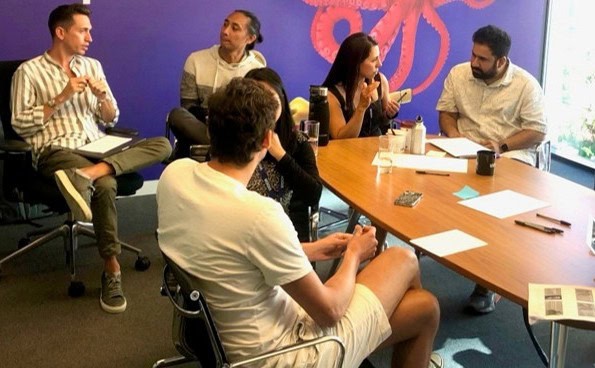
Team coaching aims to create the conditions for this kind of synchronisation in professional settings. It helps a pre-existing team, who already share objectives, history, and interdependence, to function more consciously and effectively. A team coach pays attention not just to each person, but to the space between them: how they communicate, where assumptions live, what dynamics shape behaviour, and where unspoken tensions or misalignments might be holding them back.
As a coach facilitating a team, you need to hold space and create psychological safety. A team might span generations, cultures, working styles, and power levels. There may be underlying dysfunctions or longstanding patterns that need to be brought to the surface. Yet the opportunity is huge: when a team begins to understand its own ‘collective brain,’ its performance and creativity can expand far beyond the sum of its parts.
Group Coaching: A Different Approach
Group coaching serves a very different purpose. Rather than working with an established team, the coach facilitates a group of individuals who have come together with a shared interest, challenge, or developmental goal, but they are not bound by a shared mission in the way a team is.
This creates a rich learning environment, but one focused on individual development rather than collective performance. In a group coaching setting, participants learn from each other’s perspectives, broaden their thinking, and gain insight into their own patterns and possibilities. The coach’s role is to foster connection and psychological safety, yet the ultimate outcomes lie with each person’s personal growth and next steps.
A group may contain people from different organisational levels, sectors, or even countries. Some may have existing relationships; others may be complete strangers. The diversity can be energising, but it also requires the coach to navigate complexity thoughtfully while keeping the focus on each participant’s unique journey.
Continue Exploring
For a deeper dive into the nuances of team and group coaching, Jo Wheatley and Zoe Hawkins unpack the topic brilliantly in The Coaching Crowd podcast.
And if team coaching sparks your interest, keep an eye out for the launch of our Coach House Diploma in 2026 – team coaching will be one of the key modules, and we’re excited to share more details soon.